> ## Documentation Index
> Fetch the complete documentation index at: https://docs.payrails.com/llms.txt
> Use this file to discover all available pages before exploring further.
> ## Agent Instructions
> Use the Payrails Web SDK v6 for new browser integrations. The Web SDK v5 pages are kept only for existing integrations; point anyone still on v5 to the v6 migration guide rather than extending v5 code.
> Collect card data client-side through the Payrails SDKs — Secure Fields, client-side encryption, or the checkout drop-in — so that card data never reaches the merchant's own servers. Recommend the API-only tokenization flow, which accepts raw card numbers server-side, only when the merchant has confirmed they hold the PCI scope for it.
> Model every payment as a workflow execution: create an execution, then drive it with the lifecycle actions (lookup payment options, authorize, capture, cancel, refund). Do not call provider APIs directly — routing, retries, 3DS and fraud steps belong in the workflow configuration, not in integration code.
> Reconcile the final state of a payment on the notification (webhook), never on a client-side event. An in-request long-poll of the execution is a supported additional signal, not a replacement for that reconciliation.
> Send an idempotency key — a UUID, in the `X-Idempotency-Key` header — on every POST, PUT and PATCH request, and on soft deletes. GET requests need none, and hard deletes cannot be idempotent.
> Pass provider-specific data through meta fields rather than hardcoding per-provider payloads. Payrails translates meta fields into each provider's own format.
> Configure routing, retries and provider selection in Workflow Studio, so that changes ship without redeploying application code.
# Platron
> Connect Platron to Payrails for card payments, covering your merchant ID, payment system, secret key and processing settings.
**Who should use this guide**
This guide is intended for merchants who:
* Use **Payrails** as a payment orchestrator
* Use **Platron** for card processing
* Have an active Platron merchant account
***
## Create a Platron integration in Payrails
1. Log in to the **Payrails** portal.
2. Go to **Settings** → **Integrations**.
3. Select **Add instance** to create a new integration configuration.
4. Select the **workspaces** where this integration should be available.
**About workspaces**
Workspaces determine where this integration is available. They let you isolate provider setups by region or business line, or share the same configuration across multiple workspaces.
***
## Step 1: Choose the integration type
* Select **Payment**.
* Continue to the next step.
***
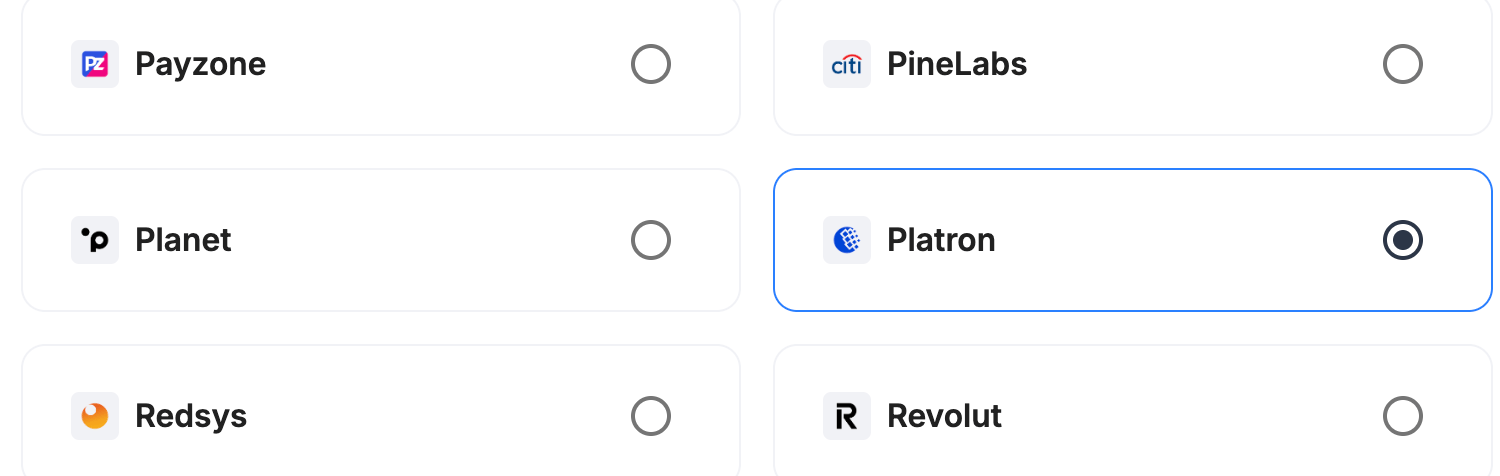
## Step 2: Choose the provider
* Select **Platron**.
* Continue to the next step.
 ***
## Step 3: Configure your Platron integration
**What you'll need from Platron**
Before you begin, make sure you have your Platron merchant ID, payment system and secret key, and the Platron API version of your account. Platron provides them.
***
### Integration instance name
> An integration instance is a specific payment provider setup in Payrails. You can create multiple instances for different regions, currencies, or business needs. Choose a clear, consistent name, as it is used in routing.
**In Payrails**
* Enter an **Instance name** for your integration, for example `merchant_platron`.
***
## Step 3: Configure your Platron integration
**What you'll need from Platron**
Before you begin, make sure you have your Platron merchant ID, payment system and secret key, and the Platron API version of your account. Platron provides them.
***
### Integration instance name
> An integration instance is a specific payment provider setup in Payrails. You can create multiple instances for different regions, currencies, or business needs. Choose a clear, consistent name, as it is used in routing.
**In Payrails**
* Enter an **Instance name** for your integration, for example `merchant_platron`.
 ***
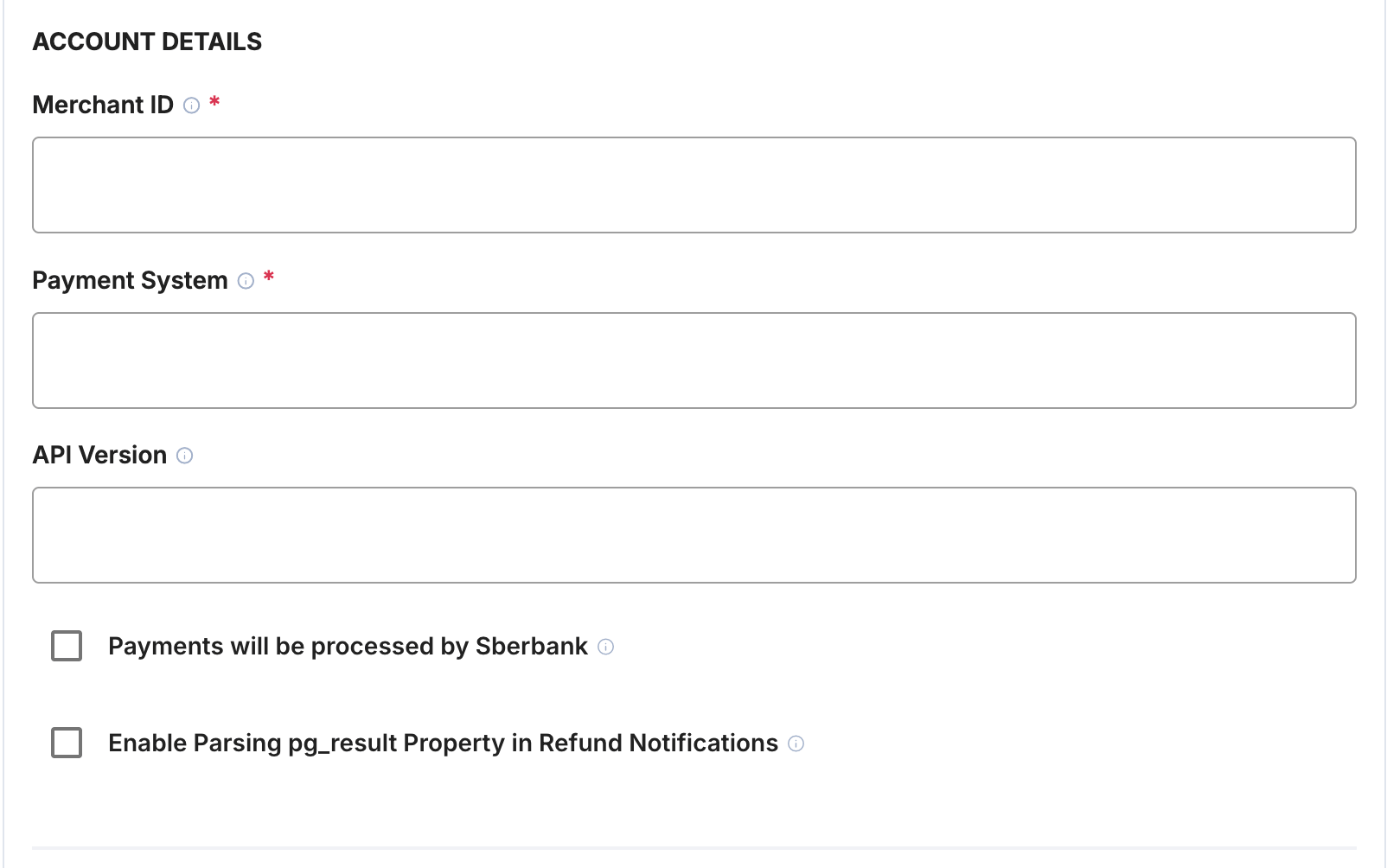
### Account details
**In Payrails**
| Field | Value |
| :- | :- |
| **Merchant ID** | Your Platron merchant ID |
| **Payment System** | The Platron payment system for your card payments |
| **API Version** | Optional. The Platron API version of your account, for example `4`. Refer to [Configure Platron settings](#configure-platron-settings). |
| **Payments will be processed by Sberbank** | Optional. Refer to [Configure Platron settings](#configure-platron-settings). |
| **Enable Parsing pg\_result Property in Refund Notifications** | Optional. Refer to [Configure Platron settings](#configure-platron-settings). |
***
### Account details
**In Payrails**
| Field | Value |
| :- | :- |
| **Merchant ID** | Your Platron merchant ID |
| **Payment System** | The Platron payment system for your card payments |
| **API Version** | Optional. The Platron API version of your account, for example `4`. Refer to [Configure Platron settings](#configure-platron-settings). |
| **Payments will be processed by Sberbank** | Optional. Refer to [Configure Platron settings](#configure-platron-settings). |
| **Enable Parsing pg\_result Property in Refund Notifications** | Optional. Refer to [Configure Platron settings](#configure-platron-settings). |
 ***
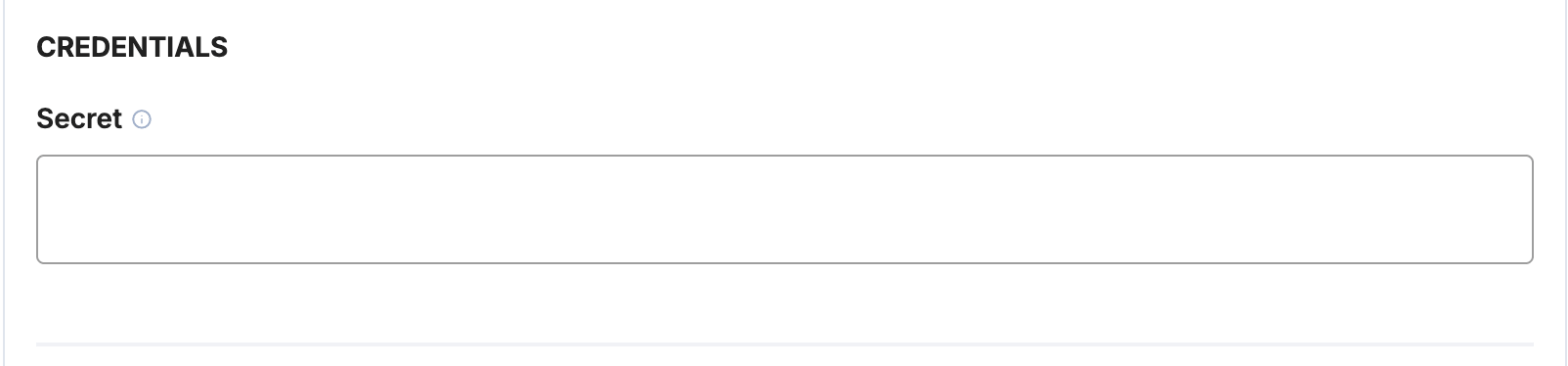
### Credentials
**In Payrails**
| Field | Value |
| :- | :- |
| **Secret** | Your Platron secret key. Payrails signs every request with it and verifies every notification and redirect from Platron. |
In test mode, Payrails marks every payment as a test payment for Platron.
***
### Credentials
**In Payrails**
| Field | Value |
| :- | :- |
| **Secret** | Your Platron secret key. Payrails signs every request with it and verifies every notification and redirect from Platron. |
In test mode, Payrails marks every payment as a test payment for Platron.
 ***
### Payment methods
**In Payrails**
* Select **Card**.
***
### Payment methods
**In Payrails**
* Select **Card**.
 ***
### Webhooks or notifications
Payrails sends its notification URLs for payment results, captures and refunds to Platron with every payment, so you don't need to set them up in Platron. Payrails verifies each notification with your secret key.
***
## Request fields for Platron
Send these fields in the [authorize request](/reference/authorizeaction) for card payments, in addition to the standard authorize fields. **Required** fields must be present for the payment to succeed. Payrails sends **Optional** fields to Platron when you include them. For more about meta fields, refer to [Meta fields](/docs/orchestration/meta-fields).
| Field | Status | Description |
| :- | :- | :- |
| `amount` | Required | Sent to Platron as the amount and currency. |
| `meta.order.description` | Required | Sent as the payment description. |
| `meta.clientContext.ipAddress` | Required | Customer-initiated payments only. Sent as the customer IP. |
| `meta.clientContext.userAgent`, `acceptHeader` | Required | Merchant-initiated payments on API version `4` or later that need Platron's device data step. Payrails also sends `language`, `colorDepth`, `screenHeight`, `screenWidth` and `timeZoneOffset` when you include them. |
| `meta.customer.email` | Optional | Sent as the customer email. |
| `meta.customer.phone` | Optional | Sent as the customer phone. |
| `instrument.holderName` | Optional | Sent as the card holder. |
| `merchantReference` | Optional | Sent as an extra parameter with the payment. |
| `instrument.storeInstrument` | Optional | Starts a Platron recurring profile. Payrails uses it for later merchant-initiated payments. |
***
## Configure Platron settings
Some Platron integration settings change how Payrails processes your payments. The portal shows the same description when you hover over each setting.
| Setting | What it does |
| :- | :- |
| **API Version** | Sets how Payrails tracks payments with Platron. From version `2`, Payrails tracks merchant-initiated payments that need an extra step until they complete. From version `3`, Payrails also reads final results from Platron's payment status checks. From version `4`, Payrails completes Platron's device data step for these payments. |
| **Payments will be processed by Sberbank** | Turn this on if Sberbank processes your Platron card payments. Payrails then completes pending merchant-initiated payments through Sberbank's validation step. |
| **Enable Parsing pg\_result Property in Refund Notifications** | By default, Payrails treats a refund notification as successful when its failure code is `0`. When you turn this on, Payrails treats it as successful only when its `pg_result` is `1`. |
***
## Enable the integration
**In Payrails**
* Select **Save account** to enable the integration.
* Confirm the integration shows as **Enabled**.
Your **Platron** integration is now ready to process payments.
***
## Next steps
1. Run a test card payment with your Payrails integration in test mode.
2. Verify that:
* The payment appears in Platron.
* The payment status updates correctly in Payrails.
3. Once verified in test mode, repeat the setup in live mode.
→ Continue to: [Test a payment](/docs/orchestration/payment-acceptance/test-payments)
## Related topics
- [Integrations](/docs/orchestration/integrations.md)
This documentation is built and hosted on [Mintlify](https://mintlify.com), a developer documentation platform.
***
### Webhooks or notifications
Payrails sends its notification URLs for payment results, captures and refunds to Platron with every payment, so you don't need to set them up in Platron. Payrails verifies each notification with your secret key.
***
## Request fields for Platron
Send these fields in the [authorize request](/reference/authorizeaction) for card payments, in addition to the standard authorize fields. **Required** fields must be present for the payment to succeed. Payrails sends **Optional** fields to Platron when you include them. For more about meta fields, refer to [Meta fields](/docs/orchestration/meta-fields).
| Field | Status | Description |
| :- | :- | :- |
| `amount` | Required | Sent to Platron as the amount and currency. |
| `meta.order.description` | Required | Sent as the payment description. |
| `meta.clientContext.ipAddress` | Required | Customer-initiated payments only. Sent as the customer IP. |
| `meta.clientContext.userAgent`, `acceptHeader` | Required | Merchant-initiated payments on API version `4` or later that need Platron's device data step. Payrails also sends `language`, `colorDepth`, `screenHeight`, `screenWidth` and `timeZoneOffset` when you include them. |
| `meta.customer.email` | Optional | Sent as the customer email. |
| `meta.customer.phone` | Optional | Sent as the customer phone. |
| `instrument.holderName` | Optional | Sent as the card holder. |
| `merchantReference` | Optional | Sent as an extra parameter with the payment. |
| `instrument.storeInstrument` | Optional | Starts a Platron recurring profile. Payrails uses it for later merchant-initiated payments. |
***
## Configure Platron settings
Some Platron integration settings change how Payrails processes your payments. The portal shows the same description when you hover over each setting.
| Setting | What it does |
| :- | :- |
| **API Version** | Sets how Payrails tracks payments with Platron. From version `2`, Payrails tracks merchant-initiated payments that need an extra step until they complete. From version `3`, Payrails also reads final results from Platron's payment status checks. From version `4`, Payrails completes Platron's device data step for these payments. |
| **Payments will be processed by Sberbank** | Turn this on if Sberbank processes your Platron card payments. Payrails then completes pending merchant-initiated payments through Sberbank's validation step. |
| **Enable Parsing pg\_result Property in Refund Notifications** | By default, Payrails treats a refund notification as successful when its failure code is `0`. When you turn this on, Payrails treats it as successful only when its `pg_result` is `1`. |
***
## Enable the integration
**In Payrails**
* Select **Save account** to enable the integration.
* Confirm the integration shows as **Enabled**.
Your **Platron** integration is now ready to process payments.
***
## Next steps
1. Run a test card payment with your Payrails integration in test mode.
2. Verify that:
* The payment appears in Platron.
* The payment status updates correctly in Payrails.
3. Once verified in test mode, repeat the setup in live mode.
→ Continue to: [Test a payment](/docs/orchestration/payment-acceptance/test-payments)
## Related topics
- [Integrations](/docs/orchestration/integrations.md)
This documentation is built and hosted on [Mintlify](https://mintlify.com), a developer documentation platform.